Elon Musk’s recent interview with Lex Fridman sent me on an existential rabbit hole about our jobs and our future. But to explain why, I need to rewind a bit.
Six years ago, I was in a French café in Bali, eating pain au chocolat and macarons while reading Yuval Harari’s Homo Deus. The pastries were delicious but the book was a punch in the gut, especially his concept of “dataism” toward the end.
Harari suggested that our cognitive and emotional abilities are becoming obsolete in managing the vast data flows of the 21st century, increasingly outpaced by powerful, non-conscious algorithms. These machines wouldn’t just outperform us in physical and cognitive tasks, stripping us of economic value — but also become our primary sources of authority and meaning (as opposed to our thoughts and feelings) by simply processing data better. Hence a shift from humanism to dataism.
He wrote:
Dataism says that the universe consists of data flows, and the value of any phenomenon or entity is determined by its contribution to data processing. […] From a Dataist perspective, we may interpret the entire human species as a single data-processing system, with individual humans serving as its chips.
If humankind is indeed a single data-processing system, what is its output? The creation of a new and even more efficient data-processing system, called the Internet-of-All-Things. Once this mission is accomplished, Homo sapiens will vanish.
This left me deeply unsettled: are humans really just a collection of chips, hacked over millennia by the Information God, destined to create better and more powerful processing systems?
Existential crisis aside, after reading his books, I could see the point. Harari argued that there would be two ways to adjust to this new paradigm:
- Upgrading our brains. To even engage with these machines, he said, we’ll need to upgrade to a superior human model, Homo Deus, which will retain some essential human features but will also enjoy upgraded physical and mental abilities.
- Maximizing the data flow. In a dataist paradigm, freedom of information is the greatest good of all. So the only way to retain economic value for a person or a company is to maximize data flow by producing and connecting more and more information to the system.
Since the book came out in 2019, a lot has happened in the tech world, from the rise of ChatGPT to the first human having a Neuralink implanted in their brain, and everything in between. Which brings me back to Elon’s talk on Lex’s podcast. The shift from humanism to dataism is real, and it’s quickly unfolding before our eyes — Elon is working on solving both of the issues Harari raised.
🧠 Upgrading our brain
Neuralink has already successfully implanted two brain-computer interfaces. While they’re currently focused on addressing brain damage issues like spinal cord injuries and seizures, the long-term goal is to make this technology available to the general public. Soon enough we’ll be able to have “telepathic communication” with machines, upload our memories, and other sci-fi things like that.
Elon’s purpose in working on this isn’t so that we can keep working, but to improve our communication rate with machines, increasing the chances of alignment. (As in: the better we can interact with them, the better our chances of coexisting peacefully.)
📊 Maximizing the data flow
Through his company xAI, Elon is also developing large language models, similar to ChatGPT, that can perform a wide range of tasks. A crucial factor in building a great model is feeding it quality data (what Harari said). I initially believed this was where humans still had an edge over machines, but Elon quickly changed my mind. He said:
It’s humbling to see how little data humans have been able to accumulate. If you say: how many trillions of usable tokens have humans generated, discounting spam and repetitive stuff? It’s not a huge number, you run out pretty quickly.
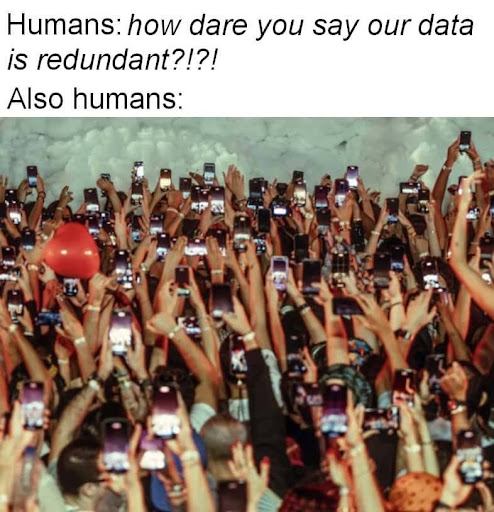
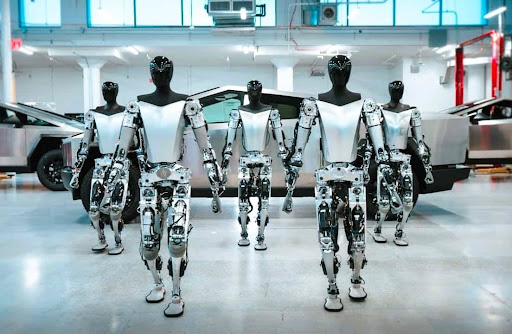
So who will provide the data? The robots themselves! Specifically, millions of Tesla cars equipped with real-time video cameras, and eventually, hundreds of millions of Optimus humanoid robots integrated into various work processes. These robots — not humans — will become the primary source of data from the real world.
These are just a few data points of a larger trend towards dataism, and the kind of change we’ll see in the next few decades. Overall, this existential trip left me with more questions than answers, such as:
- What portion of my job involves information sourcing and processing, and how much of that could be automated in the future?
- Which activities and tasks, if any, will we continue to prefer humans to perform, even if machines could do them better?
- To what extent are we already relying on algorithms to make decisions and assign meaning in our lives?
- Are we actually the last few generations of Homo sapiens who will ever walk the Earth?
- If you could enhance your brain’s capabilities and become more powerful, would you?