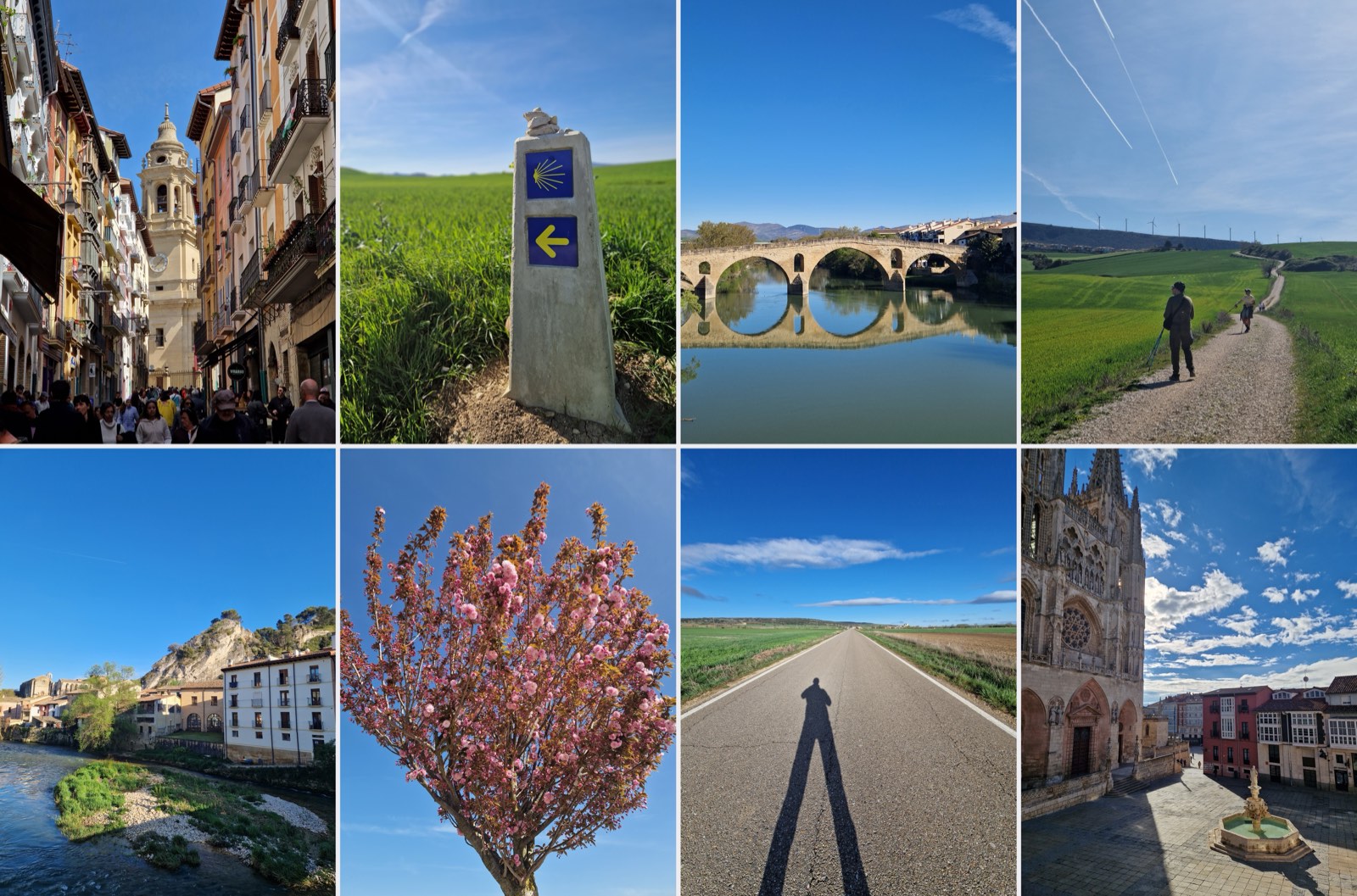
Why I went
I joined one of my best friends who invited me to do it. I went partly to make new memories and partly out of curiosity. I’d heard about the Camino for years and loved the movie The Way. Also, I’d been spending too much time at home behind screens and wanted to see new places and meet new people. I felt it could be the perfect mix of effort, adventure, and “time off”.
The Route
We walked from Pamplona to Burgos in 10 days.
- Pamplona - Uterga (17km)
- Uterga - Estella (30km)
- Estella - Los Arcos (22km)
- Los Arcos - Logroño (29km)
- Logroño - Navarrete (11km)
- Navarrete - Najera (16km)
- Najera - Santo Domingo De La Calzada (21km)
- Santo Domingo D.L.C. - Belorado (22km)
- Belorado - San Juan de Ortega (24 km)
- San Juan de Ortega - Vilafria (Burgos) (18km)
Practical learnings
The path is very well marked. You rarely need Google Maps.
Keep your bag super light. Aim for 5–6 kg max in a 28L pack. Mine was a 35L bag at 7.5 kg, which felt fine at home but grew heavier as I picked up food, water, and poles along the way. After six hours of walking daily, you feel every extra gram. You can easily wash and dry clothes on the road (machines are everywhere) so three pairs of socks, underwear, and t-shirts is plenty.
Transport your bag if you need to. You can ship your bag to the next destination if you need to. The service costs around €7 per leg, is well-organized, and always arrived where it was supposed to. (Note: a true pilgrim should carry its own bag, but I wasn’t one, so I used it a few times.)
Poles aren’t necessary but help. Especially if you carry your own bag, they help with the load, the mud, and the climbs.
Shoes matter, but don’t overthink them. They need to be comfortable and broken in before you go. I walked in Salomon Sense Ride 5 and had no issues. Plenty of people walked with HOKAs, which I think are great for the cushioning (but less practical with mud).
Vaseline on your feet every morning. Combined with anti-blister socks (I used Danish Endurance), it’s the single best thing you can do. I didn’t get any! Also take your shoes off during every break to let your feet breathe. Regardless, bring needle, lighter, and thread for popping blisters if you get them.
Walk at a sustainable pace. The most experienced pilgrims do around 20 km/day. Doing 35 km every day to cover ground faster is how people get injured. Also, you won’t enjoy it much.
Earplugs are non-negotiable. Even if you stay in Airbnbs (like we did), you’ll often share a room — and someone will snore. I slept badly five nights out of ten and it took a real toll. Invest in the best earplugs you can find. In small towns like San Juan de Ortega, a hostel is your only option anyway.
The stretch from Pamplona to Burgos was quiet (even during Easter!). Most pilgrims only walk the final 100 km to Santiago, the minimum required to receive the Compostela certificate. For the first few days, we were almost completely alone on the trail. I kept asking locals, “Where are all the pilgrims?!” 😄 Apparently May is much busier. From day four on, though, we started meeting more people, and it really enriched the experience.
Food and accommodation are refreshingly cheap. A craft beer and a decent chicken sandwich for €4.80. A good Airbnb for three people for €66 a night. After overpaying for everything everywhere right now, it felt like a small miracle.
Personal observations
- I completely underestimated what the Camino asks of you. It looks accessible — everyone can walk, and you see plenty of people in their 60s doing it — but it’s no joke. You walk four to six hours a day, often in heat or cold, eating whatever you find on the road (which sometimes it’s basic), sleeping in unfamiliar beds, sometimes in hostels with strangers. After enough days, it starts to wear you down unless you have a strong reason to keep going. That’s why many pilgrims don’t talk much: they are singularly focused on reaching their goal. You don’t just walk 800 km with a pack on your back without a strong motivation. My highest respect to them.
- Northern Spain was far more beautiful than I expected. So. Much. Green. Everywhere. Pamplona and Burgos are worth a visit on their own.
- Spotting a town on the horizon after hours across empty fields gave me this ancient feeling. Food, water, shelter — salvation.
- I usually listen to Whatsapp messages at 1.5x speed. On the Camino I listened at 1x. There was no need to rush.
- Days lost their names: there is no Monday or Sunday, only “Walking Day”.
- The cars speeding by on the highway felt like they belonged to another reality — like powerful technology from the future. On the final day, I actually took a bus for the last 9 km into Burgos because I wasn’t feeling well. Getting on that bus was its own small joy. Like stepping back into the future. I had a similar experience when I first heard music again after a ten-day silent retreat.
Overall, the Camino was a strong “dose of reality”. A powerful reset before going back to work.